Summary: For family health care in New York, call a clinic whose services fit the patient: Ryan Health | NENA, CHN Lower East Side Health Center, Betances Health Center, Family Health Center of Harlem, or Farrell Community Health Center for primary or family care. CHN also offers pediatrics, while Charles B. Wang Community Health Center lists internal medicine. Confirm appointments, insurance, and walk-in availability before going.
Suppose a school asks for a clinician's note when your child is ill. Before choosing between your regular primary care office, a nearby urgent care service and a family health center, you need to establish who can see the patient and what the visit involves. An unfamiliar clinic name alone does not answer those questions.
A search for a family health center nearby should end with a phone call, not a guessing game. The closest clinic is not always the right one. What matters is the patient's age, the care needed today, the insurance card in your hand, and the clinic's actual walk-in policy.
When using searches such as family medicine clinic near me, family medical clinic near me and family health services near me, compare the service descriptions rather than treating every result as the same kind of clinic. The six New York options below are worth calling first because each has a clear care type and address, which gives you enough to ask the practical questions before leaving home.
| New York center | Address on the linked clinic page | Service to ask about | Availability question |
|---|---|---|---|
| Ryan Health NENA | 279 East 3rd Street | Primary care for families | Can the office register each family member who needs care? |
| CHN Lower East Side | 255 East Houston Street | Primary care and pediatrics | Does the office accept the child's age group for the intended visit? |
| Betances Health Center | 280 Henry Street | Primary care | What is required for a new-patient appointment? |
| Charles B. Wang Community Health Center | 268 Canal Street | Internal medicine | Is the intended adult medical visit available at this location? |
| Family Health Center of Harlem | 1824 Madison Avenue | Primary care | Can the office assess the concern within the needed timeframe? |
| Farrell Community Health Center | 610 West 158th Street | Family medicine | Which ages and visit types can the office accommodate? |
How to use this shortlist: This is a service-and-location comparison, not a ranking of clinical quality or a report of patient outcomes. The order does not establish that a clinic is better than another. Start with the service named in each listing, then ask the office to confirm whether that service is available for the patient and visit you have in mind.
The linked clinic pages are starting points for checking location and service information. They do not establish current appointment availability, insurance participation for a particular plan, or the price of a visit. Keep those questions separate when comparing offices: a location match does not settle the payment question, and a service listing does not reserve an appointment. The call prompts below are suggested questions, not evidence that the author visited the centers or tested their booking process.
1. Ryan Health | NENA: primary care for families
Ryan Health | NENA provides primary care for families at 279 East 3rd Street, New York, NY. The clearest fit is a household trying to keep adults and children tied to one primary care setting rather than treating every sore throat, refill issue or school form as a separate urgent care decision.
A same-day caller should ask whether Ryan Health | NENA has walk-in availability or a cancellation slot for the specific patient, because primary care for families does not automatically mean no appointment needed. The useful phone script is short: name the symptom, age, insurance plan and whether the visit is for a new or returning patient.
Ryan Health | NENA is a stronger first call when the problem sounds like primary care rather than a procedure or specialty visit. A parent arranging care for a child and an aging parent in the same week should ask whether both can be registered at the same site, because the value of a family center rises when records, medications and follow-up instructions stay in one place.
If the office cannot see both people during the same period, ask whether it can book separate appointments and what information each patient needs to provide. That answer helps distinguish a shared care location from a single visit that can cover two family members.
2. CHN Lower East Side Health Center: pediatrics plus primary care
CHN Lower East Side Health Center offers primary care and pediatrics at 255 East Houston Street, New York, NY. The pediatric listing makes this a practical call when the patient is a child and the question is not just being seen, but being seen by a site that names children's care directly.
A caregiver should ask whether pediatrics is available for the child's age and whether new patients are being accepted for same-day or near-term visits. The phrase best family clinics near me is too broad for a sick child, because a family clinic without pediatrics may still redirect younger patients elsewhere.
CHN Lower East Side Health Center also fits an adult who wants primary care at the same location family members may use. The trade-off is that a clinic offering both primary care and pediatrics may have different appointment rules by age group, so the phone call should name the child or adult need before asking about hours.
For a child with a fever, describe the symptom and the school's request when calling, then ask whether the visit can address both the illness and the needed note. The listing confirms pediatrics and primary care, but the clinic has to confirm what it can handle in a particular appointment.
3. Betances Health Center: primary care on Henry Street
Betances Health Center offers primary care at 280 Henry Street in New York, NY. If you are seeking a general medical visit, use the primary care listing to frame your questions about the intended service. Do not treat this comparison as a recommendation to choose a clinic instead of hospital or specialty care when those have been advised.
A caller should treat the primary care label as the opening clue, not as a guarantee of same-day access. Ask whether Betances Health Center takes walk-ins, whether a new patient can be seen for an acute issue, and whether insurance verification happens before the visit or at check-in.
If you are considering Betances Health Center for a current concern, describe that concern to the office and ask whether its primary care service is the appropriate setting; this list cannot determine how long a symptom can safely wait. Medication questions, recurring symptoms, forms, screenings, and non-emergency illness all call for a different conversation than a one-time urgent care visit, because the clinic may need prior records or a new-patient intake before a clinician can act.
When you call about a recurring symptom, explain when it began and whether the patient has already seen another clinician about it. That gives the office a clearer basis for deciding whether to offer a primary care appointment or send the caller elsewhere.
4. Charles B. Wang Community Health Center: internal medicine
Charles B. Wang Community Health Center offers internal medicine at 268 Canal Street, New York, NY. The clearest fit is an adult patient who needs a medical visit centered on adult primary care rather than pediatrics or whole-family registration.
If you are considering internal medicine for an adult with ongoing medications, chronic conditions or a new symptom, ask the office whether the intended visit belongs with that service. A caregiver calling for a parent should ask whether the center can see a new adult patient, what identification and insurance details are needed, and whether prescription history should be brought to the visit.
Charles B. Wang Community Health Center's Canal Street listing is a starting point for checking services, not a reason to infer an age restriction. A family medical centre near me search may show adult and child services side by side, so match the named service to the patient and confirm the accepted age group with the office.
For a parent with several prescriptions, ask whether the first appointment is meant for medication review or whether the office requires a separate visit for that concern. The listing identifies internal medicine, but it does not specify appointment availability or the documents the clinic requires.
5. Family Health Center of Harlem: primary care in Harlem
Family Health Center of Harlem provides primary care at 1824 Madison Avenue, New York, NY. The name and listed service make it a reasonable first call for a patient who wants a primary care setting and is checking whether the center can handle a same-week medical need. A caller should ask about access before talking about reviews or directions: does the center see new patients for the issue today or this week?
A clinic may be open and still appointment-only, and an online listing may not show the current wait, so the phone answer decides whether the trip is worth making.
If ongoing care is your goal, ask Family Health Center of Harlem how registration and follow-up work; do not assume that its name establishes whether it is the right choice for an isolated concern. The first visit still needs a practical check: confirm the address, hours, insurance plan, patient age, and whether the visit will be billed as primary care before choosing it over another nearby option.
If the appointment is for a new concern, ask whether the center wants earlier medical records before the visit. A clear answer can help you decide what to bring and whether the appointment is set up for an initial assessment or a continuing-care visit.
6. Farrell Community Health Center: family medicine
Farrell Community Health Center provides family medicine at 610 West 158th Street, New York, NY. Use the family medicine listing as the starting point for asking about the intended medical visit. Confirm the services and patient ages available at this location rather than assuming that the label answers every question about scope or access.
A caller who needs care the same day should ask if Farrell Community Health Center is seeing new patients for family medicine, and whether the clinician can handle the specific problem. Family medicine covers a lot of ground, but the clinic still decides whether a rash, fever, blood pressure issue, refill request, or follow-up belongs in a same-day slot.
A caregiver arranging care across generations should ask Farrell Community Health Center whether its family medicine service accepts each patient's age group and intended visit type. The practical issue is whether the person who needs care today can be seen under the same registration and insurance rules. A strong fit on paper still goes nowhere if the visit cannot be booked.
When scheduling a follow-up after an earlier visit, explain that connection and also describe any new or changing symptoms. Ask the office whether to arrange a follow-up or a different appointment. The purpose is to give the scheduler an accurate account, not to fit the concern into a booking label yourself.
How to choose the right family health center before you leave home
Before leaving home, establish whether the clinic can offer the intended visit for the patient:
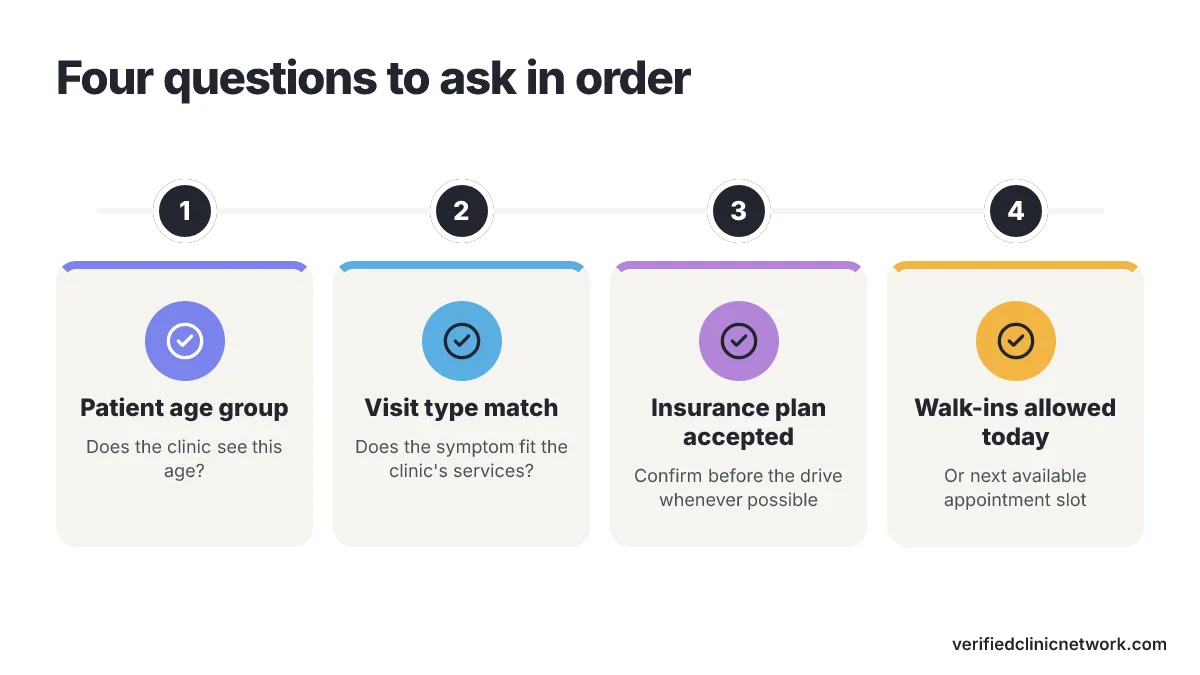
- Patient age: Does this location see the patient's age group?
- Visit type: Can the office handle the concern you describe, or does it recommend a different setting?
- Insurance: Does it accept the exact plan for that service and clinician?
- Access: Are appointments required, or are walk-ins being accepted today?
Use the answers to compare practical fit rather than relying on distance or reviews alone. The diagram below summarizes the same call sequence; it does not establish which clinic has availability.
A search result for family medicine clinic near me or family medical clinic near me should be sorted by care type before ratings. Pediatrics, internal medicine, primary care and family medicine are not interchangeable when the patient is a child, an adult with several medications or a parent trying to set up longer-term care.
A phone call should use plain details rather than a long story. Say: I need care today for a child with a fever, or I am calling for my parent who needs a primary care visit and has Medicare, then ask whether the clinic takes the plan and whether walk-ins are being accepted.
Insurance confirmation should happen before the drive whenever possible. An insurance card may list a network name, plan type and member services number, but the clinic still needs to say whether it accepts that plan for the visit you are trying to book.
Reviews should break a tie, not make the first decision. A clinic with strong comments but no same-day access will not solve the problem in front of you, while a clinic that confirms your plan and offers a visit today has already answered the most important question.
Keep a short note for each call with the clinic name, address, appointment offer and any insurance instructions. If one center cannot see the patient, ask whether it recommends another care setting; do not assume the next clinic on a search page has the same services or appointment rules.
This guide appears on Verified Clinic Network, and its directory listings should be treated as a starting point for checking the details with the clinic rather than as confirmation of a visit or insurance coverage. The Verified Clinic Network overview explains the directory's focus, and the same call-first approach applies when a search sends you from a directory page to a clinic website.
National health-center information is background reading, not a booking tool for a particular New York office. The HRSA news and updates page provides a place to read the agency's updates, but national information does not answer whether a chosen office can register or see the person who needs care. Keep the distinction clear when checking a directory: background about the health-center system is not a confirmation from a local scheduler.
Funding announcements and appointment availability answer different questions. HRSA's New Access Points awards page is background on a funding program; it should not be treated as a schedule for these clinics. HHS also describes funding for dental care for children with neurodevelopmental disorders, a different care need from choosing a routine family medical appointment. Use the HRSA awards information for program context, while directing appointment and payment questions to the clinic and the patient's plan. None of these links confirms that a listed New York center can see the patient today.
Ask the clinic and the patient's plan whether telehealth is an option for the intended visit. The linked CMS physician fee schedule fact sheet discusses mental health telehealth and in-person visit requirements, but that does not establish a particular clinic's appointment options or a patient's coverage. Keep the question specific: can this office offer the intended service remotely, and what does the plan require? Do not assume that a policy discussion about mental health visits applies to every routine primary care appointment.
When to follow emergency-care instructions
If a nurse line, clinician or clinic recording has already told you to seek emergency care, follow that instruction rather than continuing to compare routine family health appointments. This guide compares clinic listings; it is not a symptom assessment and should not replace instructions already given for the patient's situation.
Checking online tools and other location guides
When online clinic information is incomplete, use the office's own instructions to confirm the visit rather than assuming that an online form is an appointment. The linked Clincy website describes an AI treatment coordinator for dental practices. That is a dental-practice product, not evidence that a family health center on this list uses it or offers a particular booking service. Its presence here should not influence which New York medical clinic you choose. Confirm medical appointment arrangements directly with the selected office.
Patients comparing family clinics outside New York can use the same checklist before choosing from another local list. The article on family clinics near Austin follows the same practical question: who can see the patient this week, under the right service and insurance rules.
Choosing a New York family health center that fits
Start with the clinic that names the care type your family member needs, then call before you travel. Give the patient's age, symptom, insurance plan and new-patient status, and ask whether the clinic is taking walk-ins or same-day appointments.
The next action takes less time than reading another page of reviews: choose two centers from this list, call both, and write down the answer on hours, insurance and appointment rules. If one clinic confirms the visit and the other stays unclear, book the confirmed option and bring the insurance card, medication list and identification to check-in. The advice stops at choosing a family health center for a clinic-level problem; the clinic's own instructions decide what happens after the call.
Frequently Asked Questions
Which family health center near me in New York offers pediatrics?
CHN Lower East Side Health Center lists both pediatrics and primary care at 255 East Houston Street, New York, NY. It may be a useful call for a child or an adult seeking primary care at the same location. Ask whether pediatrics is available for your child’s age and whether the center is accepting new patients or can offer a same-day or near-term appointment.
Which of these New York centers offers family or primary care?
Ryan Health | NENA provides primary care for families at 279 East 3rd Street. Betances Health Center lists primary care at 280 Henry Street, and Family Health Center of Harlem lists primary care at 1824 Madison Avenue. Farrell Community Health Center offers family medicine at 610 West 158th Street. Call the center that fits your needs to confirm appointments, insurance, and walk-in availability.
Which listed center is a fit for adult primary care?
Charles B. Wang Community Health Center lists internal medicine at 268 Canal Street, New York, NY. The article identifies it as a fit for an adult needing care centered on adult primary care, rather than pediatrics or whole-family registration. When calling, ask whether the center can see a new adult patient and what identification or insurance details are needed.
What should I ask when calling a New York family health center near me?
Explain who needs care, the patient’s age, the issue, and whether the patient is new or returning. Ask whether the center offers the care needed, has an appointment or walk-in availability, accepts the patient’s insurance, and can see them today or soon. The article recommends confirming these details before going, since a listed service does not guarantee a same-day visit.
What should I ask if I am uninsured or unsure about costs?
Ask the office about self-pay charges, any financial-assistance process, and what the quoted charge includes before agreeing to a visit. Do not infer a price or discount from the phrase community health center. Explain whether the intended visit involves a new concern, follow-up, forms or medication questions, then ask whether the office can estimate the charges for that service.
If you have coverage but are unsure whether it applies, ask both the office and the plan about the location, clinician and intended service. Record any instructions about referrals, records and registration. This list does not quote clinic prices, promise financial assistance or confirm coverage for an individual plan.
Related reading
- Brain Cancer Treatment Centers in Tacoma: Compare Care
- 6 Family Clinics Near Austin to Call for Care This Week
- 4 Best 3 St Paul Fibroid Treatment Centers to Call First
- 5 Alaska Stroke Care Centers: Hospitals and Rehab Options