Summary: Ohio walk-in options listed include iMed Urgent Care on South High Street, Hometown Urgent Care on Clime Road, On Time Urgent Care, and Buckeye Immediate Care on East 16th Avenue in Columbus. OhioHealth Urgent Care Polaris Parkway offers same-day care, while Lower Lights provides walk-in primary care for established patients. Call ahead to confirm availability, location, visit fit, and payment details.
The school nurse calls, and your child needs a same-day exam before class starts again. The pediatrician's next opening is too far off.
You already have the insurance card in your hand, and the search box says urgent care clinic near me. At that point, the question is not which name sounds nicest. It is which place can take the visit you actually need.
Ohio walk-in care is not one thing. A walk-in urgent care visit, a same-day primary care visit, and a walk-in option for established patients can look alike online. Once you arrive, they may work very differently.
The practical move is to check fit before name recognition. Confirm the walk-in rule, the location, the care type, and the payment basics before you leave home.
This is a Columbus-focused Ohio shortlist, not a statewide quality ranking. The options below were included for their published walk-in or same-day access information. Compare them by location, arrival rules, patient eligibility, and the questions you need answered before leaving home. Here, 'best' means a possible fit for those practical needs, not evidence of better treatment, shorter waits, or lower costs.
The listings do not establish which clinic has the strongest clinical outcomes. They also do not confirm today's staffing, appointment availability, insurance participation, or closing arrangements. Treat each listing as a starting point for checking the clinic's own information, then confirm the details that affect your visit. If you live outside Columbus, use the same comparison questions for clinics closer to home rather than treating this list as a recommendation to travel.
1. iMed Urgent Care: South High Street walk-in access
iMed Urgent Care lists a walk-in clinic at 3865 S High St in Columbus, which makes it a practical first check for someone who can get to the south side without crossing town. The useful fact is the published walk-in location, not a promise that every symptom, plan, or arrival time will be handled the same way.
A patient choosing iMed should call with one question before driving: are walk-ins being accepted now at the South High Street clinic. A second question should name the insurance plan exactly as it appears on the card, because a clinic can welcome walk-ins and still bill differently depending on the plan.
Consider iMed if its published South High Street location is practical for your journey and the clinic confirms it can handle your visit. A farther clinic with clearer availability can be the better choice if the phone call gives a firm answer sooner.
The listed address also gives the caller a concrete way to check whether iMed is a reasonable route from work, school, or home. Confirm that the location you plan to visit is the South High Street clinic, then ask whether the clinic's current walk-in process matches the visit you need.
2. Hometown Urgent Care: Clime Road walk-ins
Hometown Urgent Care says its Clime Road location takes walk-ins at 4300 Clime Rd in Columbus. That published walk-in notice is attached to a specific address, which helps a caller sort nearby choices fast.
A caregiver should treat Hometown as a strong option when Clime Road is nearby and the problem fits urgent care, not ongoing primary care. The clinic's own page is the first place to check the location. After that, the phone call is where the patient can ask whether the current queue still accepts walk-ins.
Hometown matters most when the search began as walkin in clinics near me and the first results were fuzzy about appointment rules. A walk-in label only means something after someone at the clinic confirms the day's intake process. That part gets skipped more than it should.
Keep the comparison tied to Clime Road rather than assuming that company-wide information applies at this clinic. If you need a particular service, ask whether this location provides it and whether it is available for the visit you are planning. A broad service category is not a substitute for confirmation from the clinic you intend to use.
Ask about the Columbus site you plan to visit, and don't assume every service appears at every location. When calling Clime Road, give the patient's age and the main reason for the visit before you ask about the queue.
That answer can help show whether the clinic is the right stop, and the address on the location page helps keep it from being confused with another Hometown site. If the person on the phone sounds unsure, ask for the location that is taking walk-ins right now.
3. On Time Urgent Care: Columbus urgent care and walk-ins
On Time Urgent Care offers urgent care and walk-in services in Columbus, so it belongs on the list for someone comparing local options without a fixed neighborhood requirement.
The fact given here does not name a street address, so the patient should check the location details directly before picking it over a clinic with a listed address. A search for walk in clinic vs urgent care usually starts with this exact confusion. Walk-in tells you how you enter the clinic. For example, OhioHealth's Polaris Parkway page describes care for minor illnesses and injuries. That service description is different from confirming whether you can arrive without an appointment at a particular clinic.
On Time fits a patient who wants urgent care and walk-in access in Columbus, then plans to confirm the address, hours, and insurance handling before leaving. The phone call matters more when the online listing gives fewer location details, because a generic listing can hide the practical stuff people need.
On Time's broad Columbus description makes the first call especially useful. Ask for the address of the location currently accepting walk-ins, not just the company's general location. Then confirm that the clinic can see the patient for the stated reason before setting out.
A caller comparing On Time with iMed, Hometown, or Buckeye can use the same questions for each provider. Write down the address, whether walk-ins are being accepted, and what the clinic says about the plan on the insurance card. That keeps the comparison on usable access, not on the wording of a search result.
4. Buckeye Immediate Care: East 16th Avenue walk-in access
Buckeye Immediate Care says people can walk in without an appointment at 22 E 16th Ave in Columbus. If the published location is practical for your journey, keep Buckeye on the list while you check whether it can handle your visit. Before you drive over, check how your insurance plan classifies the visit. Ask both the clinic and your insurer how the visit would be classified under your specific plan. Confirm whether any quoted payment is an estimate and whether additional services would be billed separately, rather than inferring your costs from the walk-in label.
Buckeye makes sense if you want a fixed address instead of a hospital name you recognize. Call first, ask whether they are taking people right now, and explain what is going on so you can see whether their setup fits.
The website FAQ mentions the walk-in rules. It will not tell you how many people are sitting in the waiting chairs at this moment. Phone the desk, ask whether they still take walk-ins this hour, and read the street number back to the receptionist if they start naming other properties.
Pay attention to the wording as you compare Buckeye with sites that advertise same-day care.
5. OhioHealth Urgent Care Polaris Parkway: same-day care
OhioHealth Urgent Care Polaris Parkway describes same-day care on its location page; confirm the current address and arrival process directly before traveling. The useful question is whether the clinic can accommodate the visit you need today. A same-day label does not by itself confirm a booked arrival time, an available clinician, or how the queue is managed.
If you are sorting through search results for pediatric urgent care near me, call the front desk before you head over with a sick child. The same-day care description should not be treated as confirmation of every child age limit, pediatric service, or insurance network. Ask the clinic which details apply to the child and the reason for this visit. Give them the patient's age right away, state the symptom, name your network carrier, and say when you plan to pull into the parking lot.
This location works well when you live near the north side and getting seen today matters most. If a nearer clinic confirms that it can handle the visit, compare that confirmed access with the journey to Polaris rather than assuming a same-day label makes a longer trip worthwhile. A clinic that offers same-day care does not promise you an open exam room the minute you walk in. Ask the receptionist whether the clinic can accommodate the visit now, and request the current Polaris Parkway address rather than relying on an address copied from a search snippet or a different OhioHealth location.
You can verify the location on the OhioHealth web page because it points to the Polaris Parkway facility instead of giving a broad view of their regional network. Keep your phone questions focused on the choice in front of you. Find out whether they can treat your condition today, and confirm that showing up now works for their schedule.
6. Lower Lights Christian Health Center: established-patient walk-in primary care
Lower Lights Christian Health Center uses a walk-in setup for people already in its primary care patient list over at 1160 W Broad St in Columbus. The established-patient rule is the key eligibility detail for this particular walk-in service.
It should not be read as a statement about every service Lower Lights offers to new patients. If you already receive care there, ask whether the walk-in clinic can handle your reason for visiting; do not assume that a prescription question or a recurring symptom automatically belongs in this service.
New patients should check eligibility instead of relying on the walk-in label. If you have no history with Lower Lights, ask how to arrange a new-patient visit. Call the front desk, say you're new, and ask which appointment slot opens first this week.
Lower Lights describes this service as walk-in primary care for established patients. If you are new to the practice, ask about new-patient access instead of assuming the established-patient walk-in process applies to you.
Before you drive out to Lower Lights, verify your status first.
If you are comparing primary care options outside Columbus, including a Springfield listing, apply the same eligibility checks before treating it as a backup to Lower Lights. Verify the provider's identity, location, and appointment process directly. Do not infer walk-in access from a primary care label or assume that another clinic uses the same established-patient rules.
How should you choose between Ohio walk-in options?
Choose an Ohio walk-in option by confirming its arrival rules, patient eligibility, location, and ability to handle your reason for visiting. A walk-in label describes access; it does not confirm that every urgent care service is available to every patient.
For example, the University Hospitals Rocky River urgent care opening announcement describes walk-in access without an appointment. Use the provider's current location information to check the details for your visit rather than treating an opening announcement as confirmation of today's availability.
A patient deciding between the six listings should make the first call to the closest clinic that clearly matches the care type. iMed, Hometown, Buckeye, and On Time are framed as walk-in or urgent care options in the supplied material, OhioHealth Polaris Parkway is framed around same-day care, and Lower Lights is framed as walk-in primary care for established patients.
Which clinic access model matches your visit?
Compare the clinic's published access model with your patient status before deciding where to go. This table summarizes access information, not treatment quality, live capacity, prices, or insurance coverage.
| Clinic | Published access information | What to confirm directly |
|---|---|---|
| iMed Urgent Care | Walk-in clinics, including South High Street | The location accepting patients and fit for the visit |
| Hometown Urgent Care, Clime Road | Walk-ins welcome at Clime Road | Current intake and the services needed |
| On Time Urgent Care | Columbus urgent care and walk-in clinic | Current address, arrival process, and patient eligibility |
| Buckeye Immediate Care | Walk-ins without an appointment | Current access and insurance handling |
| OhioHealth Polaris Parkway | Same-day care | Current address and whether an appointment or other arrival process applies |
| Lower Lights Christian Health Center | Walk-in primary care for established patients | Established-patient status and capacity for the visit |
A useful comparison starts with the visit rather than the clinic name. Someone already established at Lower Lights can ask about its primary care walk-in option, while a person comparing urgent care locations can ask whether each is accepting walk-ins now. A same-day listing, such as OhioHealth Polaris Parkway, calls for a direct question about whether the current arrival window works.
What should you ask a walk-in clinic before leaving?
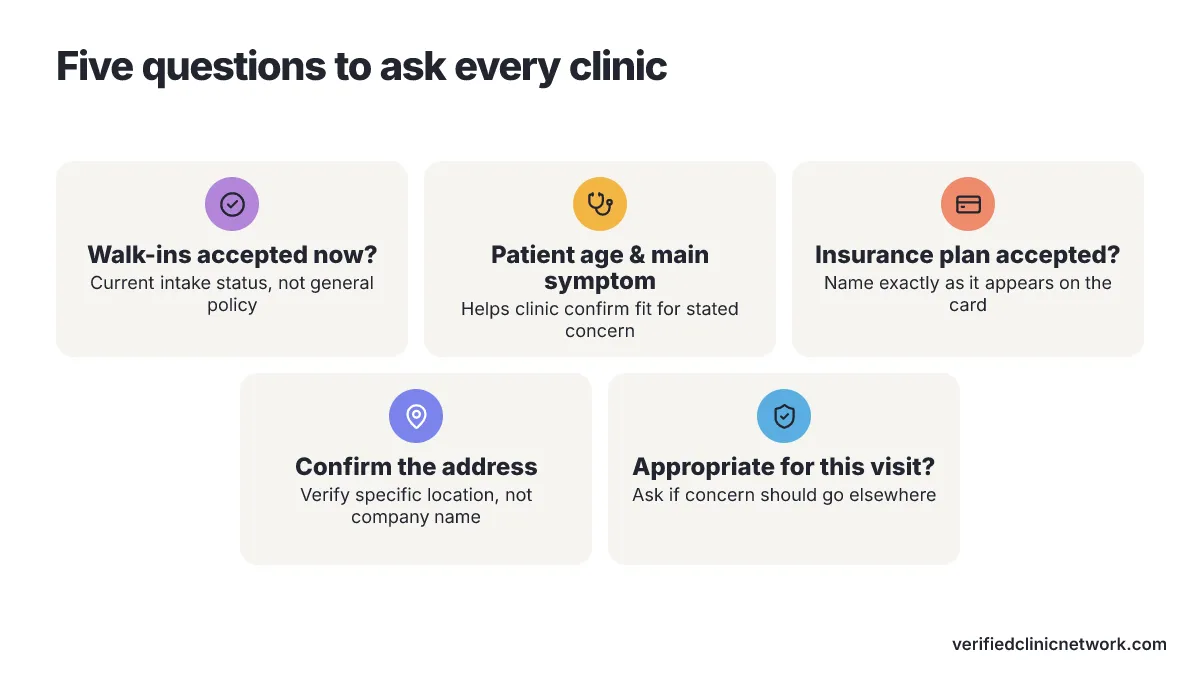
Ask whether the clinic can accept this patient for this concern, then confirm the location and payment details. Use the same short script for every clinic so the answers are comparable:
- I need to know whether walk-ins are being accepted now.
- The patient is a child, adult, or older parent, and the main symptom is the reason for the visit.
- The insurance card says the plan name, and I need to know whether you take it for this visit type.
- I need the address I should use, because I am deciding whether to drive over.
- I need to know whether there is any reason this should go somewhere else.
A clinic that answers those points clearly beats a clinic with a nicer-looking listing. A patient has only a small window before work, school pickup, or a parent's ride falls through, so a vague answer about walk-ins should move that clinic lower on the list.
Use the fifth question to check whether the clinic is appropriate for the stated concern, rather than asking only whether the doors are open.
How should you use clinic opening announcements?
Use clinic opening announcements to identify options, then verify current access with the provider. Read each announcement for its specific access rules rather than assuming that every walk-in service works alike. Knox Community Hospital's Fredericktown walk-in clinic announcement says patients do not need to be established at KCH and do not need an appointment. Mount Carmel's Franklinton care center plan describes walk-in, same-day primary care. Neither description should be stretched into a promise about another clinic's services or current intake.
Those announcements describe different access conditions. A patient considering either location should check the current clinic details before traveling, because an announcement is not a live confirmation of today's hours or intake.
What should families check about behavioral health access?
For a behavioral health concern, confirm the provider's specialty, patient eligibility, and current access process rather than relying on the words urgent care alone. The Canton Regional Chamber's behavioral health urgent care opening is an event-listing link, not confirmation here of current hours, crisis services, or patient eligibility. Use the provider's own current information to confirm what support is available rather than inferring it from the event title.
For a child or teen needing behavioral health support, ask the provider about age eligibility, the concerns it can assess, and its current arrival process. Do not assume that an ordinary medical walk-in clinic offers specialist crisis care. If emergency warning signs are present, use emergency services rather than continuing to compare routine clinic access; the safety note below explains that distinction.
How should you use reviews and directory listings?
Use reviews and directory listings to narrow your options, then confirm the practical details with the clinic. Treat reviews as context, not as the deciding factor for a visit. Look at whether comments describe the location you intend to use, how recent they are, and whether they discuss practical concerns relevant to you. A star rating alone does not establish that a clinic can accept your visit today. When the reviews leave a question unanswered, return to the clinic's published access information and ask about insurance, patient eligibility, and the address before setting out.
Verified Clinic Network is a patient-facing healthcare directory with city hubs, city and specialty pages, and individual verified clinic listings across multiple specialties. The Verified Clinic Network About page explains the directory role, which is useful when a patient wants to compare clinic names, services, insurance signals, and ratings before calling.
A directory listing can help narrow the search, but it cannot answer whether a clinic is accepting a walk-in at the moment you plan to arrive. Use clinic pages to identify candidates, then confirm current access with the clinic itself; that distinction matters most when a result shows a service category but not a specific address or intake condition.
Clinic visibility is not the same thing as choosing the right visit for a symptom. Marketing resource, not a care recommendation: <a href="https://getclinads.com/" rel="sponsored">ClinAds clinic marketing agency</a> is a marketing resource rather than evidence that a clinic is appropriate for your visit. Keep the patient decision separate from marketing visibility: confirm the clinic's access rules, patient eligibility, and ability to handle the concern directly with the provider.
When should you seek emergency care instead?
Breathing problems, bleeding that will not stop, or a change in mental status can be medical emergencies, according to MedlinePlus guidance on recognizing medical emergencies. Seek emergency help rather than waiting for a routine walk-in visit when emergency warning signs are present. This shortlist is for comparing clinic access, not deciding whether a symptom is safe to leave untreated.
Choose the clinic that confirms the right access
Make the first call to the closest clinic whose published access rule matches the visit you need today. Read the exact insurance plan name from the card, ask whether walk-ins are being accepted now, confirm the address, and write down the answer before choosing where to drive.
A useful Ohio walk-in comparison depends on checking the details that affect your visit, not on finding a perfect online ranking. The best listing is the one that turns into a real visit without a surprise at arrival: right care type, current availability, reachable location, and a clear answer on payment basics. If the first clinic cannot answer those points, move to the next option on the list instead of hoping the sign on the door fills in the missing details.
Frequently Asked Questions
What are the best walk-in clinics in Ohio listed in this article?
The article names iMed Urgent Care on South High Street, Hometown Urgent Care on Clime Road, On Time Urgent Care, Buckeye Immediate Care on East 16th Avenue, OhioHealth Urgent Care Polaris Parkway, and Lower Lights Christian Health Center on West Broad Street. Most are Columbus options. Lower Lights is specifically described as walk-in primary care for established patients; OhioHealth Polaris describes same-day care.
Which of these Ohio clinics accept walk-ins without an appointment?
iMed, Hometown's Clime Road location, On Time, and Buckeye publish walk-in access information on the clinic pages linked above. Lower Lights describes walk-in primary care for established patients. OhioHealth Polaris describes same-day care, so ask about its current arrival process rather than treating that wording as a guaranteed appointment. For any clinic, confirm that it can accept the patient and the reason for the visit before traveling.
What should I check before going to an Ohio walk-in clinic?
Call the specific clinic to confirm it is currently accepting walk-ins or has a same-day opening, and verify the address you plan to visit. Explain the patient's age and reason for the visit so staff can confirm whether the clinic is a fit. Ask how it handles your insurance plan and what payment details to expect before leaving home.
Can I walk into Lower Lights if I have never been there?
Lower Lights Christian Health Center describes its walk-in primary care clinic as a service for established patients. If you have never received care there, ask about new-patient appointments and whether any other access options apply. The established-patient rule for this service should not be treated as proof that the organization has no services for new patients. Confirm the current process before traveling.
Which listed Ohio clinics offer same-day care?
OhioHealth Urgent Care Polaris Parkway describes same-day care on its location page; confirm the current address and arrival process directly before traveling. Hometown's Clime Road page welcomes walk-ins, but that does not confirm which visits it can accommodate today. Call the specific clinic to ask whether it can see your visit today.