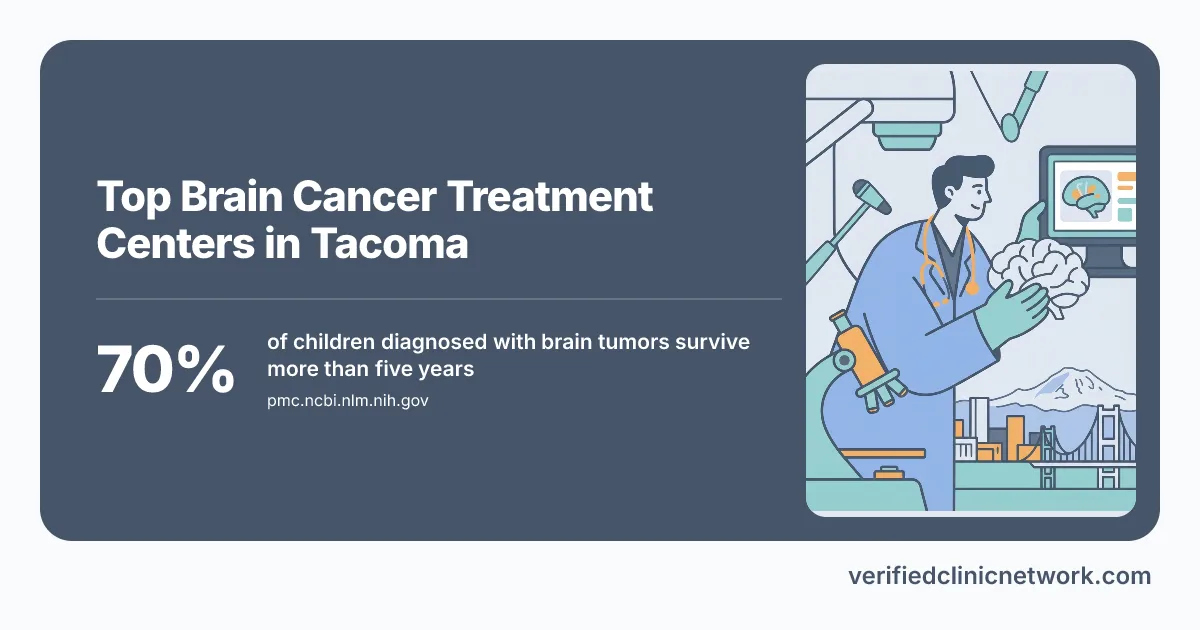
Summary: For brain cancer treatment in Tacoma, compare MultiCare Cancer Institute at Tacoma General, South Sound Gamma Knife and Virginia Mason Franciscan Health by the services your proposed plan requires. MultiCare lists brain and spine tumor care and clinical trials, while VMFH describes specialized brain tumor procedures. For children, Mary Bridge Children's provides pediatric cancer care. UW Medicine's Seattle program is included as a regional option, not a Tacoma location.
Choosing a center starts with the diagnosis and the services a proposed care plan requires, not an unsupported hospital league table. This guide compares local programs and a Seattle referral option for families researching brain cancer treatment in Tacoma. The order below is a reading order, not a ranking of survival, surgical skill or treatment outcomes. Provider descriptions establish that a service is advertised; they do not establish which program is best for an individual patient.
For a family in Tacoma, useful comparison questions are practical: who reviews the imaging and pathology, who coordinates the plan, where each appointment takes place, and how the team explains alternatives. Ask a center to identify the clinicians involved in the case rather than assuming that every specialty listed across a health system works at the same building. Keep the distinction between a regional program and a local treatment site in view throughout this comparison.
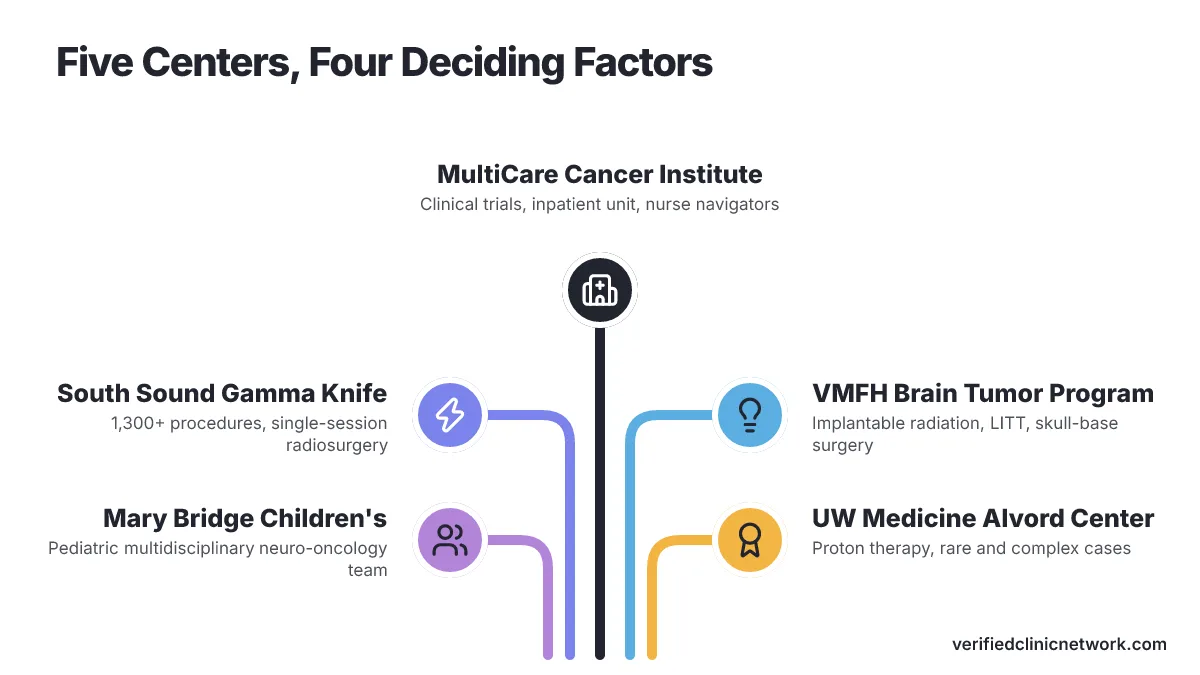
The entries below describe hospital-based cancer care, a radiosurgery program, pediatric care and a regional referral center. Some entries belong to overlapping health systems, so they should not be read as independent alternatives with directly comparable results. The comparison does not use audited center-level outcomes, patient-volume comparisons or a clinical review of an individual diagnosis.
Use the service descriptions to prepare questions, not to select a procedure before the case has been assessed. The most useful next step within the existing care-planning process is a written explanation of the recommended treatment, the reasons for it and the location where it would happen. The sections below also explain how to compare trial access, insurance arrangements and follow-up without treating a technology list as a promise of benefit.
1. MultiCare Cancer Institute at Tacoma General
MultiCare Cancer Institute at Tacoma General is a local option for comparing hospital-based cancer services and clinical trial access. Its location is 1003 South 5th Street, with medical oncology at 253-403-1677 and radiation oncology at 253-403-4994, according to the MultiCare location page.
MultiCare names brain and spine tumors among the cancers it treats and provides information about clinical trials on its cancer care page. That establishes a service area to investigate, not eligibility for a particular study. Ask which trials are currently open for the diagnosis, whether enrollment requires travel, and how the research team explains the purpose and alternatives. Trial access should not be presented as a guarantee of better results.
The original comparison also referenced a study published on PubMed. Its findings could not be verified during this revision, so no numerical survival estimates or claims about the cause of survival differences are drawn from that reference here. A national study should not be substituted for audited outcomes at this individual center.
For a caregiver, the coordination questions remain useful: who schedules the consultations, who sends the imaging and pathology for review, and who answers questions when different departments are involved? Ask whether a nurse navigator, cancer psychologist or social worker can support the particular case, rather than assuming that every support service is automatically included.
MultiCare also publishes a radiation therapy page. Use it as a starting point to confirm the planned treatment and its actual location. This comparison does not independently establish which radiation platform is available at Tacoma General for a particular diagnosis. Get the site and the responsible clinical team specified in the proposed plan.
2. South Sound Gamma Knife at St. Joseph Medical Center
South Sound Gamma Knife at St. Joseph Medical Center is a Tacoma option for discussing stereotactic radiosurgery. The provider reports more than 1,300 procedures since opening in 2005 in an August 2026 press release. This is a provider-reported activity figure, not an independent measure of safety, effectiveness or superiority over another center.
Tacoma Valley Radiation Oncology Centers describes Gamma Knife treatment as usually requiring a single session, with patients usually returning home the same day. Those statements describe the provider's published service information; they are not a recovery promise for a particular patient. Ask how the proposed procedure, follow-up and possible additional treatment apply to the actual diagnosis.
A technology name is not enough to decide whether radiosurgery belongs in a plan. Useful questions include why it is being proposed, what alternatives were considered, what it is intended to achieve, and what risks or limitations matter in the individual case. The answers should explain the choice rather than relying on the program's procedure count.
For practical planning, ask who reviews the imaging, whether another specialist's assessment is needed, and how the radiosurgery service communicates with the rest of the cancer team. Do not treat this entry as a recommendation to replace a different treatment already proposed for the case.
Insurance also needs an individual answer. Confirm coverage for the consultation, the procedure, the treating clinicians and follow-up with the insurer and center. A general statement that a service accepts an insurance program does not establish authorization or the patient's personal cost. Keep the written coverage explanation with the treatment plan.
3. Virginia Mason Franciscan Health brain tumor program
Virginia Mason Franciscan Health describes specialized brain tumor services across a regional program, including neurosurgery in Tacoma, Seattle and Silverdale. Its VMFH brain tumor page lists laser interstitial thermal therapy (LITT), fluorescence-guided surgery, awake brain mapping and real-time imaging. These are advertised program capabilities, not evidence that a particular procedure is appropriate or available at every site.
For a Tacoma family, the location question deserves its own answer. Ask where the consultation, surgery, radiation and follow-up would take place, and which clinician would coordinate them. If a procedure is offered elsewhere in the system, make the travel requirement explicit before comparing the plan with an entirely local option. Regional availability should not be shortened to a claim of availability at St. Joseph.
The St. Joseph cancer care page lists Franciscan Neurology Associates for brain tumor and brain cancer consultations. Use the current provider listing to confirm the appropriate office and referral requirements. This comparison does not establish a guaranteed appointment route, an individual surgeon's availability or a preferred operation for a specific scan.
The important trade-off is not a contest over which center has the longest technology list. Ask the team to explain the intended benefit of a proposed technique, why it fits the tumor, what alternatives exist and how recovery and ongoing care would be managed. Request clarification if a brochure describes a regional service but the written plan does not name the actual treatment site.
VMFH and South Sound Gamma Knife should also be compared with their institutional overlap in mind. The entries describe different service questions within the local care landscape, not independent evidence that either offers better outcomes. For a child's diagnosis, use the pediatric questions in the Mary Bridge section rather than transferring assumptions from an adult program.
4. MultiCare Mary Bridge Children's Hospital
Mary Bridge Children's provides pediatric cancer care, according to its cancer care service page. For a child with a brain tumor, the comparison question is how the pediatric cancer service would organize the specific case, including any assessment or treatment outside its own facilities. This entry is not a verification that every pediatric brain tumor procedure is performed on site.
Ask which pediatric specialists would review the diagnosis and where those consultations would happen. Useful subjects include neurosurgery, pathology review, radiation planning, rehabilitation and psychological support. The point is to obtain an explicit care pathway rather than infer a complete brain tumor program from a general cancer service listing.
The original article included [local provider directories](https://exa.ai/library/places?
ids=d4mtv67yh8v%2Cw8vyh46ntby%2Cbrggjz6jt0l%2C7v2q0vb3rjg%2C3zpgxzsgrn5%2Cd17rj9jm2h7%2Clgh09sv1f3h%2Cgqlx65pqvm3%2C9jmxdtpch44%2Cvgzrfmbrv23). That directory reference is not used here to establish the current appointment address. Confirm the actual clinic location using the hospital's own current instructions, particularly if consultations and treatment are at different sites.
The Children's Brain Tumor Network research paper and NCI PDQ overview remain reference links from the original article. The relevant passages could not be reliably checked during this revision, so this comparison does not quote pediatric survival percentages or attribute a treatment recommendation to those passages.
For practical planning, ask how the proposed approach accounts for the child's diagnosis and development, what follow-up support is anticipated, and whether a suitable clinical trial is available. If another hospital would provide part of the plan, ask who coordinates records and appointments between the teams. These questions preserve the pediatric focus without claiming that an adult center cannot contribute to care or that a particular hospital is the only acceptable choice.
5. UW Medicine Alvord Brain Tumor Center
UW Medicine's Alvord Brain Tumor Center is a Seattle option to compare when discussing regional referral or a second opinion.
The Alvord Brain Tumor Center at UW Medical Center Montlake offers proton therapy, Gamma Knife radiosurgery and minimally invasive skull-base surgery, and its team handles brain and spine tumors including advanced or hard-to-reach ones, per the UW Medicine brain tumor care page. Ask which UW clinic would review the diagnosis and which site would provide each recommended service. Inclusion in this guide does not establish that every treatment takes place in the same building.
The reason to include Seattle is to make regional referral part of the comparison, not to imply that distance from Tacoma predicts better care. If a second opinion is proposed, ask what question it is intended to resolve: the diagnosis, a surgical approach, a radiation technique or access to a particular service. Compare the actual recommendations rather than the reputation of the city.
Travel belongs in the decision alongside the proposed clinical plan. Ask how often attendance would be required, whether any visits can be remote, and what can be coordinated locally. Do not assume that video consultation is available for every situation or that remote review removes the need for travel.
The ABTA Treatment Center Finder is another way to identify programs for further questions. ABTA explicitly says the information is self-reported by institutions, not confirmed by ABTA and subject to change. Use the finder to prepare a discussion, not as a quality ranking or a substitute for confirmation of current services.
When comparing a Seattle opinion with a Tacoma plan, keep the written recommendations together. Note which services differ, why they differ and where the proposed care would take place. This guide does not establish that a rare tumor automatically requires transfer, or that a local plan should be preferred simply because it is closer.
How to compare the centers before you commit
Compare the proposed treatment, actual location, coordination arrangements and insurance details rather than treating the entries as an outcome ranking. This table summarizes the provider information discussed above; it does not determine suitability for an individual patient.
| Center or program | Area discussed | Published service focus | Question to resolve |
|---|---|---|---|
| MultiCare Cancer Institute | Tacoma General | Cancer services and clinical trial information | Which services and trials apply to this diagnosis? |
| South Sound Gamma Knife | St. Joseph Medical Center, Tacoma | Stereotactic radiosurgery | Why is radiosurgery being proposed for this case? |
| VMFH brain tumor program | Regional program including Tacoma | Specialized procedures and neurosurgery | At which site would each part of treatment happen? |
| Mary Bridge Children's | Pediatric cancer service | Children's cancer care | Which pediatric specialists and referral partners would be involved? |
| UW Medicine Alvord Center | Seattle | Brain tumor care including proton therapy and Gamma Knife | What question would regional review address? |
Use the same questions when reviewing each plan:
- Diagnosis: What tumor type is being treated, and has the relevant imaging and pathology been reviewed?
- Treatment: Which treatments are proposed, what is their purpose, and what alternatives have been considered?
- Team: Who reviews the case together, and who takes responsibility for coordinating the recommendations?
- Location: Which consultations, procedures and follow-up appointments take place locally, and which require travel?
- Trials: Is a study open for this particular diagnosis, what are its eligibility requirements, and what would participation involve?
- Insurance: Which clinicians and facilities are covered, what authorization is required, and what personal costs remain?
- Follow-up: Who reviews results, manages symptoms between appointments and explains what would prompt a change in plan?
Write down answers beside the corresponding program rather than relying on a general impression from a website. If an answer is uncertain, record what still needs confirmation; uncertainty is more useful than an assumed capability. A center's advertised service does not establish an available appointment or insurance approval.
For families also dealing with another diagnosis, patients searching for pancreas cancer treatment in Tacoma can review the VMFH pancreas surgery page and Northwest Medical Specialists. These are pancreatic care resources, not evidence of brain tumor expertise. Confirm the appropriate clinic and location for that separate diagnosis rather than transferring a recommendation between specialties.
What the treatment options actually look like, and what to expect
Brain tumor treatment options include surgery, radiation therapy, chemotherapy, targeted therapy and active surveillance, as outlined by Compass Oncology. This is a set of possible approaches, not a checklist that every patient should receive. Use the proposed diagnosis-specific plan to understand why an option is included or left out.
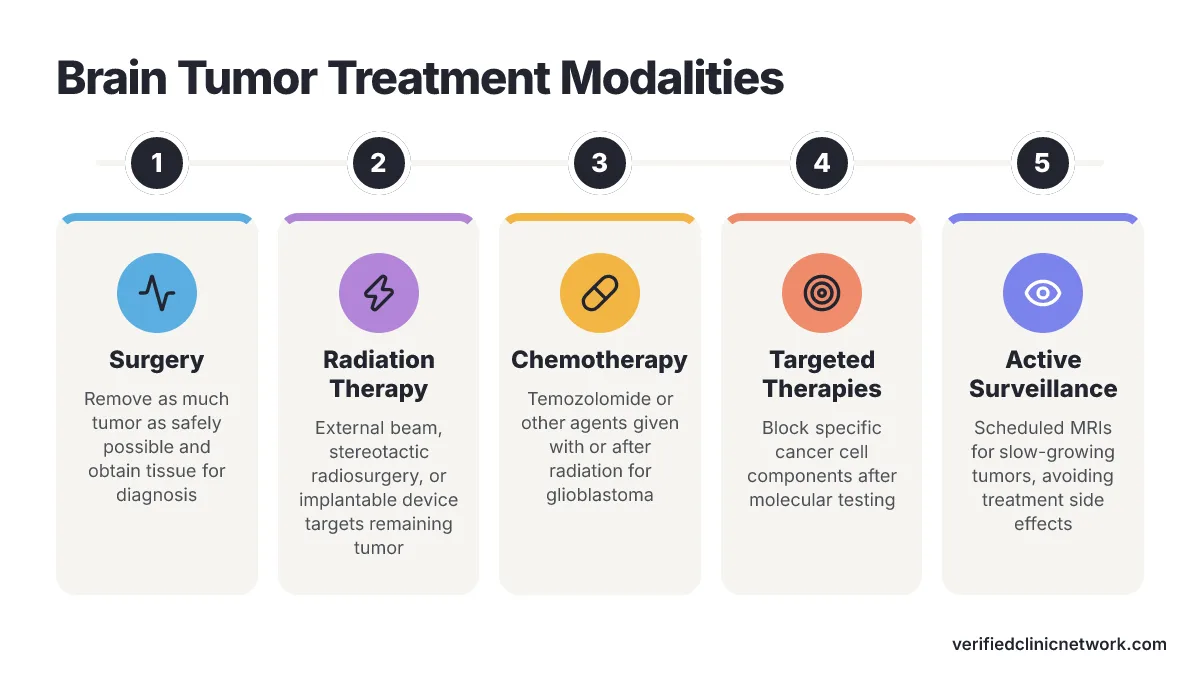
- Surgery: Ask what the operation is intended to achieve, how the proposed approach was selected and what information the team needs before proceeding.
- Radiation therapy: Ask which type is proposed, where it would take place and how it fits with any other treatment.
- Chemotherapy: Ask which medicine is being considered, the reason for its use and how the team would monitor treatment.
- Targeted therapy: Ask whether the diagnosis and any testing support the proposed medicine rather than assuming that a newer drug is necessarily a better fit.
- Active surveillance: Ask what would be monitored, how the follow-up plan is organized and what findings would prompt reconsideration. Surveillance should not be described as a guarantee of avoiding all side effects or future treatment.
For glioblastoma, Mayo Clinic describes care that may include surgery, radiation and temozolomide, and discusses Tumor Treating Fields, a wearable device delivering low-intensity electrical fields through scalp patches, in its Mayo Clinic grade 4 brain cancer overview. That overview supplies context for a discussion; it does not establish which combination is appropriate for a particular patient or which local center offers every component.
CNS lymphoma treatment has its own diagnosis-specific pathway: the National Cancer Institute's primary CNS lymphoma treatment overview includes chemotherapy among the treatment approaches. It should not be assumed to follow a glioblastoma plan simply because both conditions involve the brain.
For meningioma treatment without surgery, Mayo Clinic describes observation and radiation among the approaches considered. The choice depends on the assessed case; this comparison does not imply that observation and radiosurgery are interchangeable or that a nonsurgical approach is always suitable.
When comparing explanations, ask the team to distinguish the treatment goal, the expected trade-offs and the monitoring plan. Keep those answers separate from claims about equipment, procedure volume or convenience. A service description helps identify questions but cannot interpret an individual's imaging or replace a clinical assessment.
If you are weighing options for a parent or a child, the Verified Clinic Network FAQ covers how listings are verified and what the ratings reflect, and the about page explains how the directory checks each clinic before it appears.
For families who need a clinician in the picture while the cancer plan is being built, DDS Recruit is a dental hiring platform that supports dental professionals and practice owners with recruitment across the USA, useful if the diagnosis has left a practice short-staffed and you are arranging coverage for the family's dental care alongside oncology appointments.
When to seek urgent medical help
Seek emergency help if someone has a seizure for the first time or has difficulty breathing after a seizure, as described in NHS seizure first-aid guidance. Do not wait to finish comparing treatment centers when emergency help is needed. Follow the person's existing emergency care plan if one has been provided.
This brief safety note is not a complete symptom checklist or an assessment of the cause of a seizure. The comparison above is intended for care planning, not for deciding whether a new symptom can safely wait.
Choosing a center for your care plan
Call the nurse navigator line at the center that matches your tumor type first, and ask for a tumor board review before accepting any treatment start date. This guide does not establish a universally best adult program or a required treatment deadline. Compare the written recommendations and ask what needs clarification before making a decision.
Bring the insurance card, the imaging discs and a written list of the comparison questions. Keep the proposed treatment, responsible team, location and follow-up arrangements together so that any second opinion addresses the same information. This article compares advertised services and explains questions to ask; it does not replace the clinical team's assessment of your specific scan.
Frequently Asked Questions
What is the best brain cancer treatment center in Tacoma for adults?
This comparison does not establish a best adult center by outcomes. MultiCare lists brain and spine tumor care and clinical trial information, making it a local program to investigate. Compare the proposed plan, relevant specialists, actual treatment site and coverage rather than relying on an unsupported ranking.
Where can I get Gamma Knife treatment for a brain tumor in Tacoma?
South Sound Gamma Knife at St. Joseph Medical Center is a Tacoma radiosurgery program, described in the provider's announcement. Ask how the service would assess the particular case and how any proposed procedure fits with the rest of the treatment plan. A program listing does not establish individual suitability or recovery time.
Does Tacoma offer minimally invasive treatment for brain tumors?
VMFH's regional brain tumor program lists laser interstitial thermal therapy and specialized surgical techniques. Confirm whether the proposed technique is suitable and at which site it would be performed. The regional listing should not be read as confirmation that every technique is available in Tacoma, or as a promise of a particular recovery time.
Where should a child receive brain cancer treatment in Tacoma?
Mary Bridge Children's provides pediatric cancer care and is the pediatric service discussed in this comparison. Ask which specialists would assess the child's specific brain tumor, where each part of the care pathway would happen and whether a referral elsewhere is needed. This guide does not verify a complete on-site pediatric neuro-oncology service or a current appointment address.
Related reading
- Fibroid Treatment in St. Paul: 4 Centers to Compare
- New York Family Health Centers: Compare Care and Access
Sources
- Brain Tumors | VMFH
- MultiCare Cancer Institute - Tacoma General Hospital - MultiCare
- South Sound Gamma Knife to Sponsor and Exhibit at Washington State Neurological Society’s 22nd Annual Meeting
- Cancer Care - St. Joseph Medical Center | VMFH
- Brain Tumor Care | Brain Tumor Specialists Near You | UW Medicine
- Trends in glioblastoma treatment, survival, and disparities in access to care in the United States from 2004 to 2019: a National Cancer Database analysis